

You are on a crowded train, a client calls, and halfway through the conversation you realize the only important detail is the one you did not write down. The short answer is this: people searching for one note, pingo ai, notebook, chat gbt, and how to record a phone call on android are often looking for the same outcome — a reliable way to capture spoken information, turn it into usable notes, and find it later without extra friction.
I work on voice and communication products, and over the last few years I have seen a clear behavior shift. Users are moving away from single-purpose note apps and fragmented recorder workflows toward systems that combine call capture, voice recording, transcript generation, summaries, and searchable history in one place. I see this in product decisions and in user behavior. That trend matters whether you are a student saving lecture thoughts, a freelancer documenting client calls, or a small team member trying to keep up with zoom meeting notes, microsoft teams follow-ups, and everyday phone conversations.
AI Note Taker - Call Recorder is a mobile app for iPhone and Android that records calls and voice notes, then helps turn them into transcripts and summaries for people who need practical recall rather than a cluttered digital archive.
Recognize what users are actually replacing
At first glance, these searches seem unrelated. Someone types onenote or google keep because they want a digital notebook. Someone else looks for otter because they want transcripts. Another person searches how to record a phone call on android because they have an urgent call today and no system at all.
But the category is converging.
What used to be separate habits are collapsing into one workflow:
- Capture the conversation
- Convert it into text
- Pull out next steps
- Store it where it can be searched later
That is the real market shift. The old model treated recording, transcription, and note-taking as separate products. The newer expectation is that a call recorder, a voice recorder, and a usable journal or notepad should work together.
In practice, this means users are becoming less loyal to category labels. They may start with one note because they think they need a notebook. They may test pingo ai, google gemini, gemini ai, gpt, deepseek, meta ai, claude by anthropic, or perplexity because they think they need help organizing information. But very often, the real bottleneck happens earlier: the information was never captured properly in the first place.
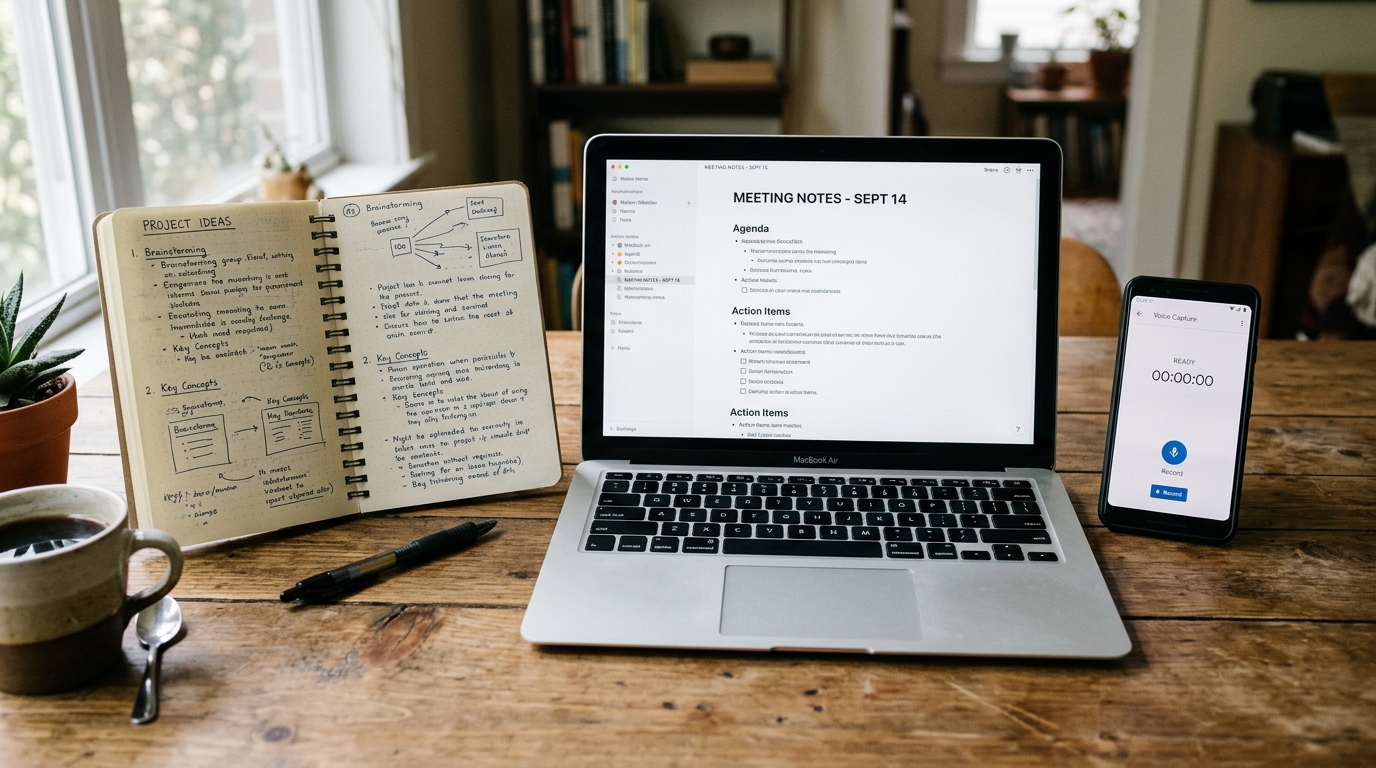
Compare the old notebook habit with the new capture-first habit
For years, the dominant pattern was manual entry. You opened a notebook app, typed fragments, and hoped your future self would understand them. That still works for simple lists. It works far less well for a fast sales call, an interview, a medical conversation, or a detailed project discussion.
Here is the difference I see most often:
| Approach | What it does well | Where it breaks down |
|---|---|---|
| Traditional notebook or one note workflow | Good for structured writing, checklists, and edited notes | Misses nuance, quotes, timing, and exact wording during live calls |
| Standalone recorder workflow | Captures the full conversation accurately | Leaves users with long audio files they rarely review |
| Capture plus transcript plus summary workflow | Preserves detail and makes it usable later | Depends on ease of use, privacy expectations, and storage clarity |
This is why generic note apps are not disappearing, but their role is changing. Instead of being the first place information enters your system, they are increasingly the place where polished output ends up. In real usage, the messy part now starts with audio.
Track why “how to record a phone call on android” keeps rising in practical importance
The phrase how to record a phone call on android is not just a setup question. It reflects a broader user behavior change: more work, service coordination, and decision-making now happens through calls that people need to remember accurately.
A few practical scenarios make this clear:
Scenario 1: A freelancer confirms scope and pricing on a call, then needs exact wording later.
Scenario 2: A parent receives detailed scheduling information over the phone while multitasking.
Scenario 3: A small business owner handles support requests, vendor updates, and follow-up tasks across short daily conversations.
Scenario 4: A job seeker reviews an interview screening call and wants a cleaner recap than scattered notes.
In all of these cases, manual notes are incomplete, and memory is unreliable. A recorder-only solution helps, but users increasingly expect the file to become something readable.
That expectation is reshaping the category. People are no longer satisfied with a simple recorder or voice memo style app. They want a tool that treats recording as the start of a workflow, not the end of one.
Separate real use cases from trend-chasing searches
Search behavior has also become noisier. People try brand names and broad assistant terms because they are exploring possibilities, not because they have a settled workflow. That is why searches around chat gbt, pingo ai, and even adjacent tools like textnow app or an answering service can appear near note-taking and call recording behavior.
In practice, these users usually fall into three groups:
- Capture-first users: they need to save a conversation now and organize it later.
- Summary-first users: they already have too many recordings and want cleaner takeaways.
- Search-first users: they are experimenting with assistant tools but have not fixed the intake problem.
The third group often wastes the most time. They compare output tools while still relying on incomplete inputs. If the call was not recorded, if the conversation details were not captured, or if the voice note is buried in a random folder, even a smart summary layer will not fully solve the problem.
Selin Korkmaz touched on this from another angle in her comparison of DeepSeek, Claude by Anthropic, Gemini AI, Perplexity, and Google Keep for real notes. I agree with her core point: tool choice matters less when your capture workflow is weak.

Choose tools based on workflow, not on labels
If you are evaluating this category today, I recommend ignoring most surface-level branding and instead testing five criteria.
- Speed at the moment of capture. If it takes too many taps, people will skip it during a real call.
- Clarity after recording. Can you quickly find transcripts, summaries, or key moments?
- Support for both calls and standalone voice notes. Many users need both, not one or the other.
- Cross-context usefulness. Does it help with regular phone conversations as well as meeting recaps, quick ideas, and follow-up notes?
- Storage and trust. Users need to understand where recordings live and how easy they are to review later.
These criteria are more useful than asking whether something is a notebook, a notepad, a recorder, or an assistant. Categories blur. Workflow friction does not.
This is also where generic alternatives show their limits. A basic notebook app is fine when you already know what to type. A plain recorder is fine when you have time to replay everything. A meeting-only tool may help in teams or a zoom join meeting setting but feel awkward for everyday personal calls. Users increasingly want one mobile system that fits all three situations reasonably well.
Avoid choosing a tool that only solves meetings
One of the clearest shifts in the market is that users do not separate “meeting capture” and “life capture” as neatly as software categories do. The same person may switch between a client update, a family logistics call, a spoken reminder, and a project discussion in a single afternoon.
That is why tools designed only for conference platforms can feel narrow. Yes, integrations for microsoft teams, teams, or a zoom meeting matter. But many people also need support for ordinary phone conversations and quick personal recordings. If the product only shines in formal meetings, it misses a large part of the real day.
That was one of the useful takeaways in the blog’s earlier piece on the Teams-friendly summary workflow. The underlying trend is bigger than workplace software: users want continuity across platforms and contexts.
Use this quick decision test before you switch apps
When people ask me what to adopt, I suggest a simple test.
Choose a notebook-style app if: your information starts mostly as typed text and you rarely need verbatim recall.
Choose a recorder-only app if: you mainly want raw audio archives and are comfortable reviewing them manually.
Choose a combined capture-and-summary app if: your problem is not just storing audio but turning conversations into action.
If you want that third outcome, AI Note Taker - Call Recorder’s call recording and voice summary workflow is designed for it. Not because every user needs more features, but because many users no longer want to bounce between separate tools just to remember what was said.
Ask the practical questions people usually ask too late
Is this for everyone?
No. If you only jot down shopping lists or occasional reminders, a simple note app may be enough.
Who benefits most?
Students, freelancers, consultants, sales professionals, support-heavy small business owners, and anyone whose important information often arrives through spoken conversation.
Who is this not for?
It is probably not for users who dislike recording workflows altogether, rarely take calls, or only need a minimalist text notebook.
What about iPhone users?
Many of the same workflow questions apply, even if setup details differ. If that is your situation, the earlier article on how to record a phone conversation on an iPhone gives a useful starting point.
Act on the trend instead of just watching it
The category trend is not really about whether one note, pingo ai, chat gbt, or the next search term gets more attention. It is about a deeper shift in user behavior: spoken information is becoming first-class input, and people expect software to make that input usable without extra cleanup.
I think that expectation will keep growing. Not because users want more complexity, but because they are tired of losing details across calls, notes, and scattered recordings. The winners in this category will be the tools that reduce the distance between hearing something important and being able to act on it later.
If you are reviewing your own workflow, start with one honest question: where do important details get lost today? If the answer is “during calls” or “inside recordings I never revisit,” then the best next step is not another empty notebook. It is a better capture system.
And if you are interested in the broader app ecosystem behind tools like this, Frontguard’s mobile app portfolio offers useful context on how focused utility apps are being built around everyday communication and coordination.